Compression Stockings: Understanding Sizes, Lengths and Compression Levels
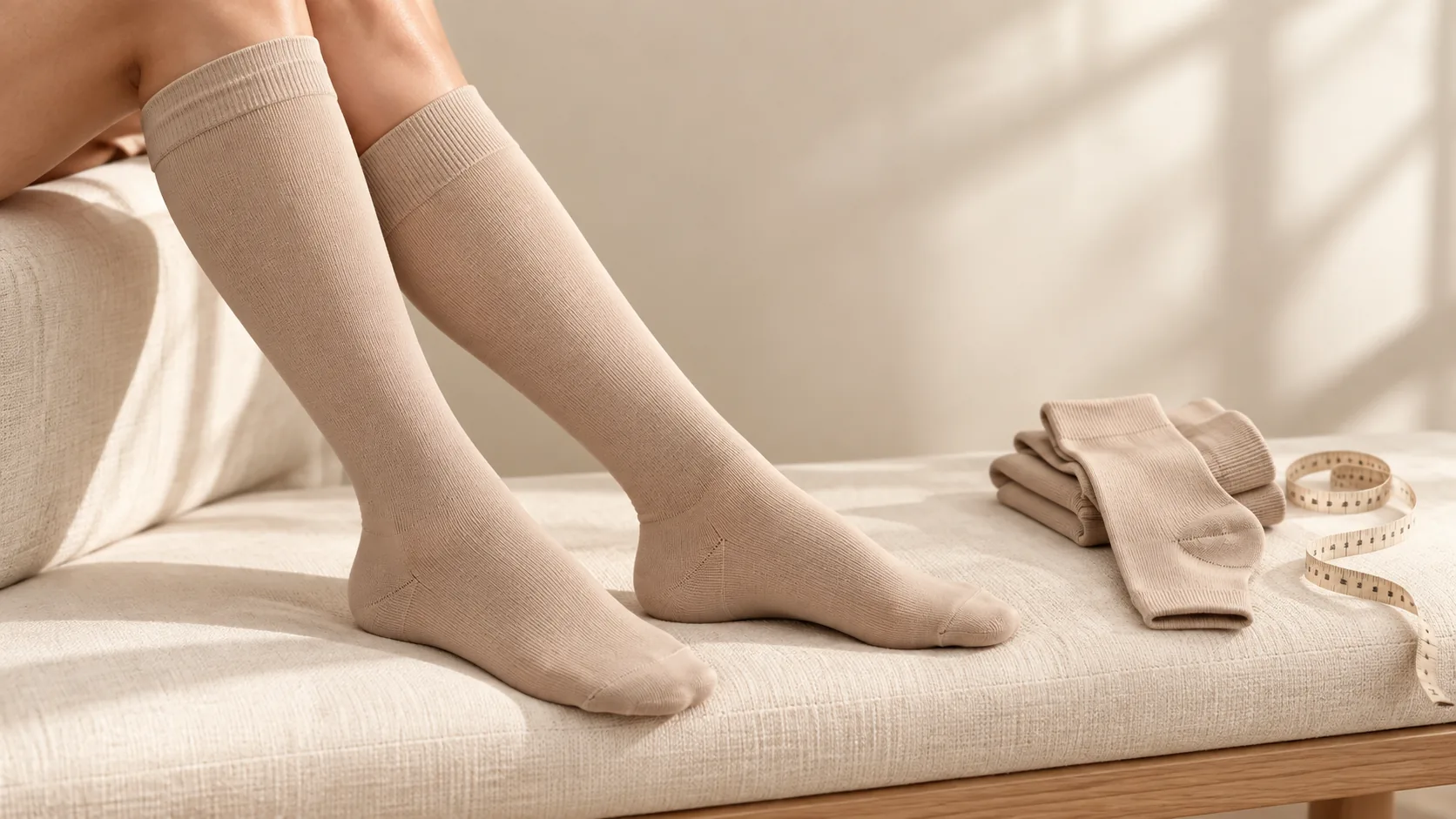
Compression stockings can look almost identical in product photographs while differing substantially in pressure, length and fit. A beige knee-length stocking is not necessarily equivalent to another beige knee-length stocking. The details on the label matter more than appearance, particularly when buying a garment recommended by a healthcare professional.
Understanding those details helps you compare products, avoid ordering the wrong variant and ask useful questions before purchasing. This guide explains compression terminology, sizing, garment lengths and everyday care. It does not select a compression prescription for you; that decision should reflect your clinical assessment and the intended purpose of the garment.
What are compression stockings?
Compression stockings are elastic garments designed to apply pressure to the legs. Medical compression may be recommended to support venous circulation and manage symptoms associated with particular conditions. The appropriate product depends on why compression is needed, rather than simply whether your legs feel tired. guysandstthomas.nhs.uk
Many products provide graduated compression, meaning pressure is greatest around the ankle and reduces further up the leg. This describes the pressure pattern, not the garment's appearance or fabric colour. CUH
Ordinary tight socks are not equivalent to a specified compression garment. Likewise, a product described as “support stockings” needs further information before it can be compared with a prescribed medical stocking.
Understanding compression levels and mmHg
Compression pressure is commonly expressed in millimetres of mercury, abbreviated as mmHg. Product labels may show a pressure range, a compression class or both. These describe the garment's compression specification and should be checked alongside its size and design.
A higher pressure rating is not automatically a better purchase. Compression must be suitable for the person and clinical purpose. Choosing a stronger garment because it sounds more effective can produce an inappropriate result.
Class labels also require care. Compression classification varies between countries and standards, so “Class 2” does not always represent the same pressure range. When comparing listings, check the actual mmHg rating and applicable standard rather than assuming class numbers are universal. PubMed
If your recommendation specifies a pressure range, do not replace it with an unclear “medium” or “strong” description. Ask the supplier for the documented compression specification.
Why professional assessment matters
Compression affects circulation, so suitability needs attention before choosing a medical garment. Certain arterial circulation problems require specialist assessment; compression can be unsafe when ankle artery pressures are low. NHS
Tell your healthcare professional about relevant circulation problems, diabetes, altered sensation or existing skin issues. These details can affect assessment and fitting. An online size guide cannot replace that evaluation. CUH
Ask three questions: What type of stocking do I need? What compression specification should I buy? What length and wearing routine are appropriate? Clear answers make shopping more straightforward and reduce the temptation to choose a garment based on reviews or price alone.
Knee-length, thigh-length and tights
Compression garments are available in different lengths, including knee-length stockings, thigh-length stockings and tights. Length determines the area covered, while compression level describes pressure. These are separate specifications. medi
Knee-length garments cover the foot and lower leg. Thigh-length garments extend higher and require suitable upper-leg sizing. Tights extend further and have additional fitting considerations. A longer garment is not automatically the correct alternative to a shorter one.
Follow the length recommended for your needs. Do not shorten a stocking by folding its top down, or substitute a different length simply because the preferred option is unavailable. If the intended length is unclear, confirm it before ordering rather than trying to adapt the garment after delivery.
Choosing the correct size
Compression stocking sizing usually requires leg measurements, not just shoe size or a familiar clothing size. Depending on the product, relevant measurements include ankle circumference, calf circumference, leg length and, for longer garments, thigh measurements. Follow the manufacturer's specific measuring chart. sigvaris.com
Small, medium and large are not guaranteed to mean the same thing across brands or models. Even products from one manufacturer can have different sizing systems. Always use the chart attached to the exact listing.
If your measurements fall into different size bands, do not simply pick the smallest size for extra compression. Ask a trained fitter or healthcare professional to assess the fit. Some leg shapes require a different garment design or a made-to-measure option. medi
Measuring and recording your requirements
A trained professional can explain the measuring points and compare your measurements with the correct chart. Measurements are often taken early in the morning, when swelling is minimal, or after appropriate management of swelling. Follow the timing advised for your situation. medi
Record the date, measurement units and values for each leg. Do not assume both legs have identical dimensions. Keep the chart or product reference used during fitting so repeat orders are easier to check. Record any prescribed differences between your left and right leg instead of assuming one specification covers both.
Reassessment may be needed if swelling, body shape or your clinical circumstances change. An old order history is useful for identification, but it does not prove that the same size remains suitable indefinitely.
Open-toe and closed-toe stockings
Open-toe stockings leave the toes exposed, while closed-toe stockings include a toe section. Both designs are available in medical compression ranges; the toe style alone does not establish the compression level. guysandstthomas.nhs.uk
Compare the specified foot fit, garment length and pressure rating before treating two toe styles as equivalent. Follow any particular toe-style recommendation given by your clinician. Personal preferences and footwear may also influence comfort within suitable options.
An inspection opening in an anti-embolism stocking should not be confused with an ordinary open-toe design. Check the product description carefully, particularly when the photograph shows only the foot section or a folded garment. CUH
Medical compression and anti-embolism stockings
Anti-embolism stockings are used in particular clinical situations to help reduce clot risk when mobility is reduced. Their use follows assessment and a care plan. A stocking provided during a hospital stay should not automatically be substituted for a medical compression garment intended for another purpose. CUH
Product names can overlap in everyday conversation, which makes the stated intended use especially important. Look for the precise garment type rather than relying on “compression socks” as a complete description.
If replacing hospital-issued stockings, confirm the product requirements and wearing instructions with your care team. Do not transfer a routine from one compression product to another without checking whether it applies.
Putting stockings on and checking fit
Follow the application instructions for your garment. Position the heel correctly and work the stocking gradually up the leg, distributing the material smoothly. Avoid twisting, overstretching or leaving folds and wrinkles. Do not roll or fold the top into a tight band. guysandstthomas.nhs.uk
If application is difficult, ask about an appropriate stocking aid, suitable gloves or assistance. Difficulty putting a garment on is a reason to review technique and fit, rather than automatically choosing a different compression level. Kent Community Health NHS Foundation Trust
Stockings should not cause new numbness, tingling or concerning skin changes. Remove them and contact your healthcare professional if these occur. Seek prompt medical advice for significant pain or changes in circulation. Kent Community Health NHS Foundation Trust
Wearing schedules, washing and replacement
Ask when to put your stockings on, when to remove them and how long the prescribed routine should continue. Many medical compression routines involve daytime wear, but some clinical situations use different schedules. Overnight use should follow specific professional instructions. guysandstthomas.nhs.uk
Washing directions depend on the product. Check the care label for cleaning method, permitted temperature and drying instructions. Do not assume a routine suitable for ordinary socks is appropriate for a compression garment.
Inspect for tears, damaged elastic or changes in fit. Replacement timing varies by garment and use, so follow manufacturer guidance and scheduled reviews. A stocking can require replacement even when its colour and overall appearance still look acceptable. Kent Community Health NHS Foundation Trust
Comparing online listings before buying
Before ordering, confirm the product type, documented compression level, garment length, toe style, exact size and model reference. Check the material information and care instructions, particularly if you have known sensitivities or need help handling the garment.
Read the quantity carefully. A listing may contain one stocking, one pair or multiple pairs. Compare prices using the same unit and specification; a cheaper listing is not a saving if it contains fewer garments or a different pressure level.
Avoid treating words such as “premium,” “medical” or “comfortable” as substitutes for measurable specifications. If essential details are missing, ask for clarification before purchasing. Keep a photograph of the packaging and your recommended specifications for future reference.
Shopping for compression stockings at CuraRich
CuraRich, the healthcare brand by AB Medical System, includes compression stockings within its wider healthcare range. When browsing, use the individual listing to confirm the available size, length, toe design, compression specification and pack contents. Do not assume all variants have identical features.
Start with your healthcare professional's recommendation, then match the product details to that requirement. If you cannot establish a match, request clarification instead of guessing. Knowing what the label means makes it easier to choose the intended product, maintain a clear reorder record and follow the care routine designed for you.